A Society That Trades Freedom for Safety
Written as a final opinion piece for a course examining free speech, digital rights, and democracy within South Asia.
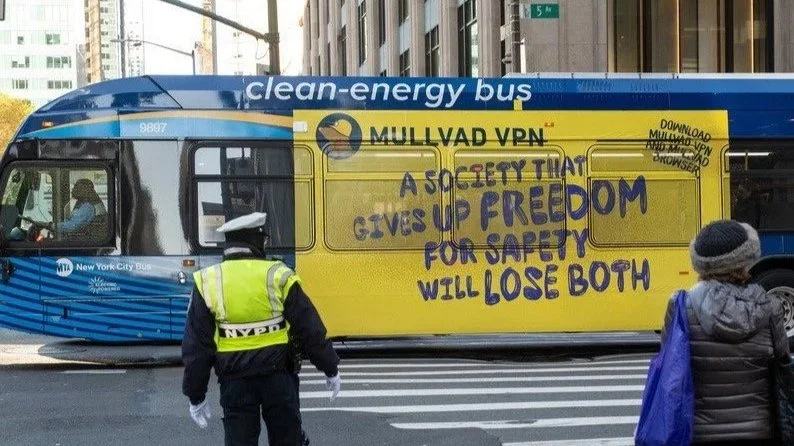
In New York City, the relentless flood of advertisements often becomes just another backdrop of the urban cityscape—a symptom of late-stage capitalism that most New Yorkers have become accustomed to tuning out. Yet, there is one billboard I encounter on my morning commute that cuts through the noise. It reads: "A society that gives up freedom for safety will lose both." This message, part of a campaign by Mullvad VPN, becomes even more resonant as I head to a class called “Fake News, Free Speech, and Democracy in South Asia,” where we dissect digital rights and censorship, particularly in India.
The night before my first encounter with the billboard, I had read about the use of Pegasus spyware to monitor—and often incriminate—journalists in India, as well as stories of frequent internet shutdowns, particularly in regions like Jammu and Kashmir. According to Access Now, a prominent organization combating global internet shutdowns, India has been the biggest offender for the past five years, with a staggering 58% of all documented internet shutdowns since 2016.
“The impacts are enormous,” said Zach Rosson, head data analyst for Access Now’s #KeepItOn project. “They're really used to silence minority voices, either in the case of Kashmir and Jammu who are religious minorities, our kind-of across the whole country,” Rosson continued, “it's a pretty aggressive tool, one of many that they employ.” Rosson also mentioned that thousands of websites are blocked and censorship is “becoming more common.”
In 2023 alone, India imposed an internet blackout, exceeding 5,000 hours in Manipur during the onset of the ethnic conflict between the Kukis and Meiteis; the internet “was completely affected for 7,956 hours,” as reported by The Economic Times.
As I step into the subway car, another message from Mullvad VPN greets me: “A free and open society is a society where we have the right to privacy; the right to our own beliefs, thoughts and emotions, and the right to decide for ourselves exactly when and with whom we want to share them. It's only in such a society that new ideas can flourish and progress can occur.” Smaller banners strung above the heads of subway riders echo similar sentiments, with lines like “Imagine a world where your inner thoughts are your own,” and “Imagine a country where people have the right to their own beliefs, thoughts, and emotions.”
Is the United States veering toward a similarly repressive path that I have been reading about in India? Discussing the issue of internet shutdowns and broader concerns about privacy and data with Zach Rosson, he suggested that the 2023 debate surrounding the ‘TikTok Bill,’ which fast-tracks the ban of the Chinese-owned app, could indicate a larger issue. TikTok is “being used as a scapegoat,” Rosson asserted, noting that many tech companies, including those based in the US, infringe on user privacy in ways that could be considered as invasive, if not more so, than TikTok.
The controversy over TikTok isn’t fundamentally about data privacy—it's about control. The US cherishes its constitutional rights, but only when it aligns with its agenda. When American authorities cannot control a narrative or a platform, they often cite security concerns, whether substantiated or not. This approach closely mirrors tactics used by other nations, such as India, where control over information and public discourse frequently leads to drastic measures like internet shutdowns.
In March 2024, the Protecting Americans from Foreign Adversary Controlled Applications Act (PAFACA) was passed by Congress and signed into law in April by President Joe Biden under the National Security Act, an appropriations bill allocating $95.3 billion in foreign aid to Ukraine, Israel, and Taiwan. This act will also ban any foreign-owned social media apps deemed “foreign adversary-controlled applications'' within 270-360 days. Why were these two seemingly unrelated issues signed under that same bill? And, why was the process so rushed?
A handful of House members, both Democrats and Republicans alike, criticized the PAFACA act for rushing the legislative process and granting excessive authority to the executive branch. Rep. Thomas Massie, R-KY, stated, “This bill gives the President far too much authority to determine what Americans can see and do on the internet.” Similarly, Rep. Tom McClintock, R-CA, argued that “The answer to authoritarianism is NOT more authoritarianism. The answer to CCP-style propaganda is NOT CCP-style oppression.”
Rep. Barbara Lee, D-CA, called for a more measured approach: “Rather than target one company in a rushed and secretive process, Congress should pass comprehensive data privacy protections and do a better job of informing the public of the threats these companies may pose to national security.”
Echoing these concerns, Jenna Leventoff, senior policy counsel at the American Civil Liberties Union (ACLU) criticized the bill as “nothing more than an unconstitutional ban in disguise.” She argued that banning a widely used social media platform that allows users to freely express themselves would be detrimental to our First Amendment rights.
This isn’t just about TikTok. The app is only the starting point, the “scapegoat,” as Rosson aptly put it, but it represents a broader, more troubling trend toward governmental overreach. As Rep. Warren Davidson, R-OH, outlined on social media, the issue at hand goes deeper than ownership and data. He stressed the need to solve the correct issues: privacy, surveillance, and content moderation. He pointed out that TikTok has significant American shareholders and that the app’s U.S. data is already stored on American soil—in Texas, held by Oracle. “What changes with ownership? I’ll be voting NO,” he said.
As I step off the subway and back into the bustling streets of Manhattan, the billboards remind me that the struggle between control and freedom isn't theoretical—it’s happening now, both here in New York and around the world.
A society that gives up freedom for safety will indeed lose both.